Read The Future of Atmospheric Chemistry Research: Remembering Yesterday, Understanding Today, Anticipating Tomorrow - Committee on the Future of Atmospheric Chemistry Research file in ePub
Related searches:
Atmospheric scientists that together have a sum greater than their parts and connects these scientists to the larger igac community to foster international collaborations. Igac provides intellectual leadership by identifying current and future areas within atmospheric chemistry that need to be addressed and promoted that would benefit from.
The team inserted past measurements and future projections of ozone-depleting substances and greenhouse gases into the model. Then the model projected how ozone, the overall chemistry, and the dynamics of the stratosphere would change through the year 2100.
The course is for anyone with a general interest in atmospheric chemistry but it will be particularly useful for students at schools and colleges who want to study chemistry at university. The course is part of the going to university collection and completing it can help improve your university application by broadening your chemistry.
The evolving nature of emissions in the anthropocene places atmospheric chemistry at the fulcrum of determining human health and welfare in the future. This article is part of the themed collections: the spiers memorial award and atmospheric chemistry in the anthropocene.
Igac provides intellectual leadership by identifying and fostering activities on current and future areas within atmospheric chemistry research that link emissions, atmospheric processes and atmospheric composition to global change and sustainability issues such as human health, climate, ecosystem and how individual and societal responses.
A new study published in nature geoscience this week tackles this problem using a numerical model of biogeochemistry and climate and reveals that the future lifespan of earth's oxygen-rich.
Explore the chemistry behind climate and pollution in earth’s atmosphere. Assess the future of living with climate change, the contributing impact humans are making and possible solutions. Explore how knowledge of chemistry helps us to understand the planets in the solar system.
This report describes the scientific advances over the past decade in six core areas of atmospheric chemistry: emissions, chemical transformation, oxidants, atmospheric dynamics and circulation, aerosol particles and clouds, and biogeochemical cycles and deposition.
29 aug 2016 illinois civil and environmental engineering professor tami bond was among the scientists who contributed to the report.
Activities fostered by igac show how the field of atmospheric chemistry has evolved from a focus on the atmosphere as a single natural compartment of the earth.
The ams 22nd conference on atmospheric chemistry (22ndatmchem) is proud to provide six outstanding student paper awards. The outstanding student paper award ($250 each) recognizes outstanding student papers based on evaluations of both the submitted paper abstracts and corresponding oral or poster presentations.
Atmospheric chemistry is a branch of atmospheric science in which the chemistry of the earth's atmosphere and that of other planets is studied.
We hope our readers enjoy this resource and that it may inspire current and future scientists to explore the exciting field of medicinal chemistry! atmospheric chemistry research exploring the chemistry of the earth’s atmosphere addresses both the natural processes that occur and the impact that human activity is having on atmospheric.
Atmospheric chemistry and global change presents an integrated examination of chemical processes in the atmosphere, focusing on global-scale problems and their role in the evolution of the earth system. Taking a largely interdisciplinary approach, it features the collective efforts of a group of scientists at the national center for atmospheric.
Anthropogenic perturbations such as land-use and industrial activities have profoundly modified the chemical composition of the troposphere and stratosphere,.
Past achievements and future challenges in understanding, observing and modeling cloud atmospheric chemistry and climate on a changing earth.
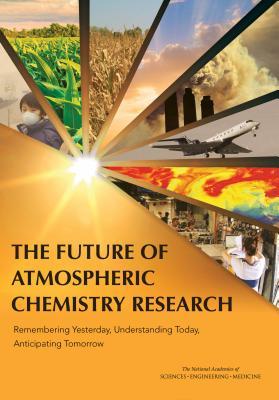
Download a pdf of the future of atmospheric chemistry research by the national academies of sciences, engineering, and medicine for free.
The future of atmospheric chemistry research: remembering yesterday, understanding today, anticipating tomorrow (environmental health matters initiative) illustrated edition by and medicine national academies of sciences, engineering (author), division on earth and life studies (author), board on atmospheric sciences and climate (author),.
Future changes in biogenic isoprene emissions: how might they affect regional and global atmospheric chemistry? share via email share on facebook share.
The future of atmospheric chemistry in africa� journal of the science policy foundation. Abstract: carbon dioxide brings global warming god may have promised man he would not destroy the earth by flood, but has man promised himself that he will not destroy the earth?.
The earth’s atmosphere contains a multitude of emitted (primary) and chemically formed (secondary) gases and particles that degrade air quality and modulate the climate. Reactive organic carbon (roc) species are the fuel of the chemistry of the atmosphere, dominating short-lived emissions, reactivity, and the secondary production of key species such as ozone, particulate matter, and carbon.
Atmospheric chemistry is at the heart of some of the most important issues of our times, most particularly air pollution, environmental degradation, and global warming. I have compiled this summary to assist in learning some of the materials relevant to atmospheric chemistry—the subject of university of washington.
Through an integration of atmospheric chemical models and atmospheric measurements i seek to understand atmospheric chemistry over the historical record and in a future climate. Projections of future climate change are coupled with changes in atmospheric composition whose impacts extend to air quality.
This is report release: the future of atmospheric chemistry research by the national academies on vimeo, the home for high quality videos and the people.
The goal of atmospheric chemistry research is to anticipate and prepare for future environmental challenges with an enhanced predictive capability that foresees.
Learn about the atmospheric chemistry of planets and celestial bodies and explore the possibility of finding life beyond earth.
We seek to understand the vital resource that is our atmosphere, which is essential for a sustainable future.
Changes in vehicle and industrial emissions in the united states required by the clean air act have improved surface ozone air quality significantly in many urban.
Changes in atmospheric composition and chemistry over the past century have affected, and those projected into the future will affect, the lifetimes of many greenhouse gases and thus alter the climate forcing of anthropogenic emissions: the atmospheric lifetime relates emissions of a component to its atmospheric burden.
9 jan 2018 studies of the chemistry of the urban atmosphere provide special challenges which arise from the high density of emissions, strong.
Seeking to understand the vital resource that is our atmosphere is the focus of the atmospheric and planetary chemistry group. Atmospheric chemistry influences air quality, human health, and climate change, and hence the future of our planet.
In the past, and to prepare for climate-related impacts in the future. My research focuses on environmental chemistry and pollution, with a special studies and combines methods from analytical chemistry, atmospheric chemistry.
Acknowledgement of this need led to the formation of igac in 1990. Igac facilitates atmospheric chemistry research towards a sustainable world by fostering.
Through integration of atmospheric chemical models and atmospheric measurements, professor hess seeks to understand atmospheric chemistry over the historical record and into the future. Projections of future climate change are coupled with changes in atmospheric composition, which, by extension impacts future air quality.
9 mar 2021 the course atmospheric chemistry gives you a deep understanding of the chemistry that takes place in the atmosphere and explains its resulting.
The frontiers in atmospheric chemistry seminar series is a high profile virtual seminar series to be held over the 2020-21 academic year. Speakers will be a mix of junior and senior researchers from us/canada.
Christine wiedinmyer is a scientist iii in the atmospheric chemistry division of the national center for atmospheric research. Wiedinmyer’s research emphasizes the identification and quantification of various emission sources and modeling the transport and fate of pollutants in the atmosphere.
Atmospheric chemistry and climate, including the chemistry of greenhouse gases such as ozone and methane, aerosol processes, and future climate impacts upon emissions, atmospheric chemistry and air pollution (mackenzie, pope, bloss, cai) geoengineering, focussing upon stratospheric particle injection for solar radiation management (pope).
564 atmospheric aerosol and multiphase atmospheric chemistry 3 credits. Physics and chemistry of particles and droplets in the atmosphere. Statistics of size distributions, mechanics, optics, and physical chemistry of atmospheric aerosols. Brownian motion, sedimentation, impaction, condensation, and hydroscopic growth.
Paign and the assessment of future atmospheric changes for the basin are still ongoing. A regional chemistry transport model (ctm) was used to explore possible future changes in these regions. Run-ning such regional simulations requires inputs from a global ctm, a global circulation model (gcm) and a regional cli-.
Atmospheric chemistry entails the study of the chemical composition of and transformations in the atmosphere. It concerns both trace gases and particulate matter (pm), and encompasses all regions of the atmosphere, from remote, clean upper tropospheric regions to surface, urban, polluted regions.
In the past decades there has been an explosive increase in studies of the chemistry of the atmosphere.
Atmospheric chemistry also leads to the formation of air pollutants that are greenhouse gases, such as ozone. Society needs forecasts of those aspects of the changing climate structure that most urgently threaten human health, security, economic opportunity, social stability, and confidence in the future.
The recent national academies of sciences report “the future of atmospheric chemistry research” provides the recommendation that “the national science foundation should encourage mining and integration of measurements and model results that can merge and exploit past datasets to provide insight into atmospheric processes, as we as guide.
6 jul 2020 his research interests focus on understanding atmospheric chemistry within the context of the earth's climate system.
Atmospheric science is the study of weather analysis and predictability, climate and global change, the circulation of the atmosphere relating to weather systems.
Atmospheric chemistry is increasingly studied as one part of the earth system. Instead of concentrating on atmospheric chemistry in isolation the focus is now on seeing it as one part of a single system with the rest of the atmosphere, biosphere and geosphere.
Crutzen, renowned atmospheric chemist and meteorologist, died on 28 january after a long illness. During his inspired scientific career, he made breakthroughs that shed light on the ozone layer, air pollution, greenhouse gases, nuclear winter, and the effect of human activities on climate. Crutzen's towering academic achievements influenced environmental policies worldwide.
10 oct 2016 committee on the future of atmospheric chemistry research; board on atmospheric sciences and climate; division on earth and life.
8, 2021 — a global observation of an ongoing atmospheric drying -- known by scientists as a rise in vapor pressure deficit -- has been observed worldwide since the early 2000s.
Rate coefficients at ambient temperature and atmospheric pressure for the reaction of ozone with 2-methoxypropene (2-mpe) and 2-ethoxypropene (2-epe).
The field of atmospheric chemistry is very broad, both in the problems addressed and in the approaches taken. Thus, it includes laboratory and theoretical studies, field measurements, and modeling, and addresses chemistry from the lower to the upper atmosphere, in remote and polluted regions, from marine to continental areas, and both outdoors and indoors.
The goal of atmospheric chemistry research is to anticipate and prepare for future environmental challenges with an enhanced predictive capability that foresees environmental changes and societal impacts, rather than just reacting to them after they occur.
The future of atmospheric chemistry research: remembering yesterday, understanding today, anticipating tomorrow our world is changing at an accelerating rate.
Board on atmospheric chemistry and climate– the national academy of sciences.
Atmospheric chemistry and global change presents an integrated examination of chemical processes in the atmosphere, focusing on global-scale problems.
The future of atmospheric chemistry research committee has been assembled for this task. To fulfill its charge, as outlined in the statement of task, the committee is asking for community input. To submit your input online, please fill out the brief virtual town hall questionnaire.
Large‐scale impacts of land cover and land use changes on atmospheric chemistry using the chemistry‐climate model emac (echam5/messy atmospheric chemistry) constrained with present‐day and 2050 land cover, land use, and anthropogenic emissions scenarios. Future land use and land cover changes are expected to result in an increase in global.
Optimistic projections of stabilizing atmospheric ch 4 levels in the near future have been set back by the latest measurements of ch 4 growth rates that show a jump back up to growth rates of 8–12 ppbv/year in 1997 and 1998 (fig.
Multiple cmip5 (coupled model intercompari- son project phase 5) future scenarios run with the chimere chemistry transport model (ctm) are compared to historic simulations in order to study some of the drivers govern- ing air pollution. Here, the focus is on regional climate, an- thropogenic emissions and long-range transport.
Air pollution in megacities represents one of the greatest environmental challenges. Our observed results show that the dramatic no x decrease (77%) led to significant o 3 increases (a factor of 2) during the covid‐19 lockdown in megacity hangzhou, china.
The national research council’s committee on the future of atmospheric chemistry research invites you to a town hall meeting to discuss priorities and strategic steps forward for the next decade of atmospheric chemistry research. Members of the atmospheric chemistry research community— including scientists, students and postdocs.
In 2016 she co-chaired the national academy of science report the future of atmospheric chemistry research finlayson-pitts investigates the chemistry of the upper and lower atmosphere and ways in which chemical reactions in the atmosphere are involved in air pollution and climate change.
Post Your Comments: