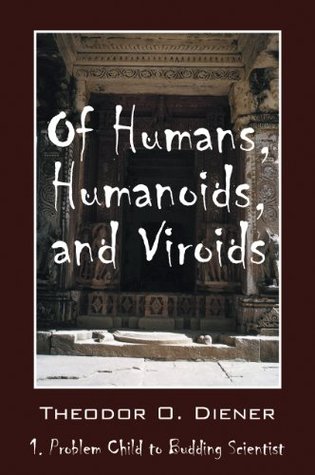
Download Of Humans, Humanoids, and Viroids: 1. Problem Child to Budding Scientist - Theodor O Diener | PDF
Related searches:
Of Humans, Humanoids, and Viroids: 1. Problem Child to Budding
Of Humans, Humanoids, and Viroids: 1. Problem Child to Budding Scientist
Of Humans, Humanoids, and Viroids by Theodor O. Diener
Sequence Similarities between Viroids and Human MicroRNAs
Viroids: self-replicating, mobile, and fast-evolving noncoding
Role of microRNA (miRNA) and Viroids in Lethal Diseases of Plants
Viroids, Virusoids, and Prions Microbiology
Prions and Viroids Boundless Biology
Viroids - Definition, Types, Examples and Diseases
Different rates of spontaneous mutation of chloroplastic and nuclear
miRNAs and viroids utilize common strategies in genetic - Frontiers
Sequence Similarities between Viroids and Human - X-MOL
1 Rolling-circle replication of viroids, viroid-like satellite RNAs and
Viroids, Virusoids, and Prions – Microbiology
6.4: Viroids, Virusoids, and Prions - Biology LibreTexts
6.4 Viroids, Virusoids, and Prions - Microbiology OpenStax
21.4 Other Acellular Entities: Prions and Viroids - Biology
Viroids: Discovery, Structure and Multiplication
Prions, Viriods and Virusoids - Virology
How are viruses, viroids and prions related? HowStuffWorks
Difference Between Viruses, Viroids, and Prions Konsyse
Subviral particles: viroids and prions (video) Khan Academy
Viruses and viroids (1VIRUK)[Overview] EPPO Global Database
Viroids: structure and function.
Viroids-Structure, Characteristic Features and their Disorders
Difference Between Virus and Viroids - Microbiology Note
Chapter 18: Infectious Molecules: Prions and Viroids
IOP Conference Series: Materials Science and Engineering
Chapter 13 Characterizing and Classifying Viruses, Viroids
Of Viroids and Prions.
(PDF) Viroids and virusoids: Relics of the RNA world
Difference Between Virus and Viroids Compare the Difference
(PDF) Viroids and Viroid Diseases of Plants Beatriz Navarro
(PDF) Of Viroids and Prions - ResearchGate
Viroids: Origin, Meaning and Replication Microbiology
Chapter 6 viroids and prions
Identification of Viruses and Viroids Infecting Tomato and
Difference between Virus and Viroid Major Differences
Encyclopedia of Plant Viruses and Viroids SpringerLink
Human and humanoid robot shake hands in space 1st - Boston.com
Humanoid robots uses, risks, advantages and disadvantages
Viruses and Viroids: Insights of Pathogenicity
Infectious Molecules: prions and Viroids Basicmedical Key
Microbiology - Chapter 13 Viruses, Viroids, and Prions
Emotion and sociable humanoid robots International Journal
Telling Apart AI and Humans #1: Humans VS Humanoid Robots
Viruses and Viroids: MCQs Quiz – 1
SURVEY OF STONE FRUIT VIRUSES AND VIROIDS IN CHILE
Quiz+ Quiz 1: Humans and the Microbial World
Human-like androids have entered the workplace and may take
PPT – Viruses, Prions and Viroids Infectious Agents of
Chapter 13 Viruses, Viroids, and Prions (1) Questions and
Algorithms and Graphic Interface Design to Control and Teach
Smart piezoelectric fabric and its application to control of
Other Acellular Entities: Prions and Viroids – Biology
Viruses, Viroids, and Prions(1).pdf - Viruses Viroids and
Viroids: New and Continuing Risks for Horticultural and
Botany online: Plant Viruses and Viroids
Simultaneous Tracking and Balancing of Humanoid Robots for
Pest categorisation of non‐EU viruses and viroids of potato
[1 and of humans with creutzfeldt-jakob disease, had been waged largely alone and in some cases in the face of strenuous disagreement.
Waseda university has been one of the leading research sites for anthropomorphic robots since the late prof. Ichiro kato and his colleagues started the wabot project in 1970. Since then, just about ten years, by integrating the latest key technologies, we have developed a variety of humanoid robots including wabot-1 which is the first full-scale human-like robot made in 1973, the musician robot wabot-2 in 1984, hadaly-2 which works together with a human partner and the biped walking robot.
The two-kilo, two-feet tall robot has an inbuilt vision and sound processing capability which allows it to walk, talk and dance — just in response to human commands. Developed by delhi’s a-set training and research institute, the humanoid robot is primarily meant for research purposes and is made available to research institutes which offer robotics as a subject of study.
Viroids do not, however, manufacture any proteins, and they only produce a single, specific rna molecule. 18) and are responsible for crop failures and the loss of millions of dollars in agricultural revenue each year.
Except for a few cases, viruses are not surrounded by a membrane. Except for a few cases, viruses are not surrounded by a membrane. If present, the membrane around a virusparticle - as seen in electron microscopic images - stems usually from the host cell (see picture to the left).
1 department of plant cellular and molecular biology and plant biotechnology viroid replication, together with replication of human hepatitis delta virus,.
2020年7月8日 总共找到81,021场比赛,其中1场选择与整个hsa-mirna种子区域具有100%同一 性的501。最频繁的比赛具有hsa-mir-4286的菊花特技类病毒或.
Discovered by scientists in the 1970s, viroids affect crops like tomatoes, potatoes and fruit trees. They don't cause human disease, but they can cause crop failure, which means a huge loss of revenue for the agriculture industry each year [source: microbe world].
Start studying microbiology - chapter 13 viruses, viroids, and prions. Learn vocabulary, terms, and more with flashcards, games, and other study tools.
There are evidences that viroids and virusoids (a class of satellite rnas) were part of the so-called rna world (that preceded our present world based on dna and proteins) and for this reason.
Different viruses are able to cause disease as they contain one or more pathogenic genes encoding various antigenic proteins found present in capsid or envelope. Viroids are single stranded rna stretches without capsid, having a few hundred nucleotide length.
Additionally, one other difference between virus and viroids is that the virus contains a protein coat surrounding its nucleic acid while viroids do not contain a protein coat. Type of host besides, different types of viruses can infect different forms of hosts including animal, plant or bacterial cells but, viroids infect only plant cells.
What pathogenic agent would this gel be most effective and safe at eliminating? a) viroids on the surface of agricultural plant tissues.
Ping human motion to humanoid robots with fewer degrees of freedom [9], [10] and categorizing human motion into different behaviors for humanoid motion synthesis [11], [12]. [13] adapted captured upper body motions to humanoid robots considering the kinematic constraints such as joint angle and velocity limits.
Problem child to budding scientist [diener, theodor o] on amazon.
Potential contribution to human neurodegenerative disorders 1 neuroscience center, louisiana state university school of medicine, louisiana state.
A yacuruna resembled a human, except that the head, hands, and feet were on backward. Others claimed that these humanoids simply had webbed hands, feet, and green skin. Legend said that if a human was ever captured by a yacuruna, they would begin to transform into one, starting with their eyes rolling backward.
26 nov 2019 are virus‐like elements, viroids, important for the origin of life? will viruses they populate the soil, the oceans, the air, our human body and even our genome.
1) respiratory pathogens such as rhinovirus (the common cold) and epstein-barr virus (infectious mononucleosis) 2) sexually transmitted viruses such as herpes simplex virus (hsv) and papillomavirus (genital warts) different viruses infect every group of organisms each species of virus infects a particular group of host species, or host range.
However, in contrast to viruses, viroids so far have been restricted to the plant kingdom, although at least one viroid-related replicon is involved in a human.
The uniqueness of this encyclopedia is that all the known viruses and viroids affecting more than 1010 plant species at global level are described and the plant species are arranged in alphabetical order of the scientific name of the plant along the relevant information on 1518 viruses and viroids and is the ready-reckoner of the global plant.
Discovery of viroids: viroids were first discovered and given this name by theodor otto diener (1971), a plant pathologist working at agricultural research centre in maryland. The first viroid to be identified was the potato spindle tuber viroid (pstvd).
Cookies enable you to enjoy certain features, social sharing functionality, and tailor message and display ads to your interests on our site and others.
Humanoids need all the human senses: touch, smell, sight, hearing and balance to function properly. The hearing sensor is important for the humanoid to hear instructions, decipher them and carry.
A product and graphic designer in hong kong has fulfilled a childhood dream by building a realistic humanoid robot that is a dead ringer for hollywood actress scarlett johansson and was created.
8 jul 2020 viroid microrna rna interference human plants� messenger rna tween viroids and mature hsa-mirnas, and the e-value (fig.
Transform membrane glycoprotein, prpc, to the prions form prpsc. Cells die, release prions into bloodstream to reinfect other cells.
They are single-stranded circular rna molecules which vary in length from 246 to 463 nucleotides and are found only in plants. Of the 27 viroids characterized so far (table 1; figure 1), 25 infect dicotyledonous plants and the other two infect monocotyledonous plants.
They are composed solely of a short strand of circular, single-stranded rna that has no protein coating. All known viroids are inhabitants of angiosperms, and most cause diseases, whose.
Viroids consist only of a short strand of circular rna capable of self-replication. The first viroid discovered was found to cause potato tuber spindle disease, which causes slower sprouting and various deformities in potato plants (see figure \(\pageindex1\)).
• viroids are unique plant pathogens that are smaller than viruses and consist of a short single-stranded circular rna without a protein coat (diener, 1971). • these pathogens cause damage to a number of economic important crops. Traditional detection methods for viroids include hybridization.
Humans, also known as humes (ヒュム, hyumu?), hyur and humanoid, are a recurring race that appears throughout the final fantasy series. Based almost entirely on the real-world species, humans are usually the most numerous and politically dominant sapient species in any given final fantasy world, particularly in the main series. As the most common sapient species, they are often considered to be a standard or average to which the biology, psychology, and culture of other species and races.
As discussed by bar-joseph (1), grapevines and fruit trees are known to contain a variety of different viroids and have been cultivated in the middle east and asia for millennia. Citrus, in contrast, is believed to have been introduced from the himalayas at a much later date.
Some futurists think the singularity — the point at which artificial intelligence can match, and then overtake, human smarts — might happen in just 16 years, while others say by 2100.
Viroids are subviral, smallest known agents of infectious disease. Diener (1971) to describe the causal agent of the potato spindle tuber disease (pstv).
On the lookout for the next “extraordinary robot” video? here are 6 points to keep in mind.
Viroid-infected plants are responsible for crop failures and the loss of millions of dollars in agricultural revenue each year. Some of the plants they infect include potatoes, cucumbers, tomatoes, chrysanthemums, avocados, and coconut palms.
Utilized in many ways in the life of humans, and even in many of them, human is used as supportive devices inside and outside of the human body. The greatest change in our lives is that human beings can produce more humanoid robots that can learn, plan, reasoning, problem solve, comment, feel, have intelligence.
Prions and viroids are pathogens (agents with the ability to cause disease) that have simpler structures than viruses but, in the case of prions, still can produce deadly diseases.
One satellite rna that infects humans and that has been described by some scientists as a virusoid is the hepatitis delta virus (hdv), which, by some reports, is also called hepatitis delta virusoid. Much larger than a plant virusoid, hdv has a circular, ssrna genome of 1,700 nucleotides and can direct the biosynthesis of hdv-associated proteins.
The first human-humanoid handshake in space, burbank proclaimed.
Viroids do not, however, manufacture any proteins, and they only produce a single, specific rna molecule. Viroids are known to infect plants and are responsible for crop failures and the loss of millions of dollars in agricultural revenue each year.
29 apr 2010 it has been estimated that approximately one hundred trillion bacteria colonize the human intestine.
Alternatively, it is possible that viroids emerged more recently as polymerases parasites like was found for qb replicase and t7 polymerase. In support of this, viroids are particularly present in plants clonally propagated for long times (potato, grapevine, fruit trees, ornamental plants).
Viroids are unique systems for the study of rna structure, function and evolution. They are the minimal rna replicons characterized so far their genome is ten-fold smaller than that the smallest.
Identification of viruses and viroids infecting tomato and pepper plants in vietnam by metatranscriptomics hoseong choi 1, yeonhwa jo 1, won kyong cho 1, jisuk yu 2, phu-tri tran 3,y, lakha salaipeth 4, hae-ryun kwak 5, hong-soo choi 5 and kook-hyung kim 1,2,3,* 1 research institute of agriculture and life sciences, seoul national university.
Viruses infect all types of organisms while viroids infect only higher plants.
Viroids are the species of nucleic acid with relatively low molecular weight and a unique structure. They reproduce within the host cell which they affect in and cause variations in them causing death. Viroids are mainly classified into two families namely pospiviroidae- nuclear viroids and avsunviroidae- chloroplastic viroids.
Tses affect humans, sheep, goats, mink, deer, elk, antelope, and cats (tables 18-1 and 18-2). Instead, they cause a noninflammatory process that results in the vacuolation, or spongiosis� in the gray matter of the brain.
Viruses and viroids: mcqs (multiple choice questions) on viruses and viroids.
The five viroids isolated from grapevine (grapevine yellow speckle viroid 1 and 2 (gysvd-1 and gysvd-2), australian grapevine viroid (agvd), hsvd, and cevd) belong to the same three genera, and while three of them (gysvd-1, gysvd-2, and hsvd) appear to be widespread in table grape cultivars, only two (gysvd-1 and hsvd) are widespread in wine.
5 million years ago (extinction of paranthropus), all fossils shown are human (genus homo). 5 ka, beginning of the holocene ), all fossils shown are homo sapiens ( anatomically modern humans ), illustrating recent divergence in the formation of modern human sub-populations�.
The 30 known viroids belong to two families- pospiviroidae and avsunviroidae. 1 – pospiviroidae: members of the pospiviroidae are named after the potato spindle tuber viroid.
Problem child to budding scientist [ diener, theodor o] on amazon.
Unlike viruses, viroids consist of a single strand rna molecule and lack a protective protein coat. They were discovered in the late 1960s, and since then we’ve been trying to determine just how viroids differ from viruses. Viroid diseases in plants are caused by 29 viroids in only two families: pospiviroidae and avsunviroidae.
6 mar 2006 viroids, satellite rnas, satellites viruses and the human hepatitis from their hosts or from helper viruses for replication and propagation [1–3].
Viroids are nucleic acid species of relatively low molecular weight and unique structure that cause several important diseases of cultivated plants. Similar nucleic acid species may be responsible for certain diseases of animals and humans.
A few diseases are caused by viroids, agents that are similar to but are even simpler than viruses. Other pathogens include nematodes (roundworms), which attack many types of plants, and 2,500 species of angiosperms that live parasitically on other plants.
Code created in: 1998-08-17 european union funding: eppo has been awarded eu grant agreements for the further development of the eppo code.
Post Your Comments: